
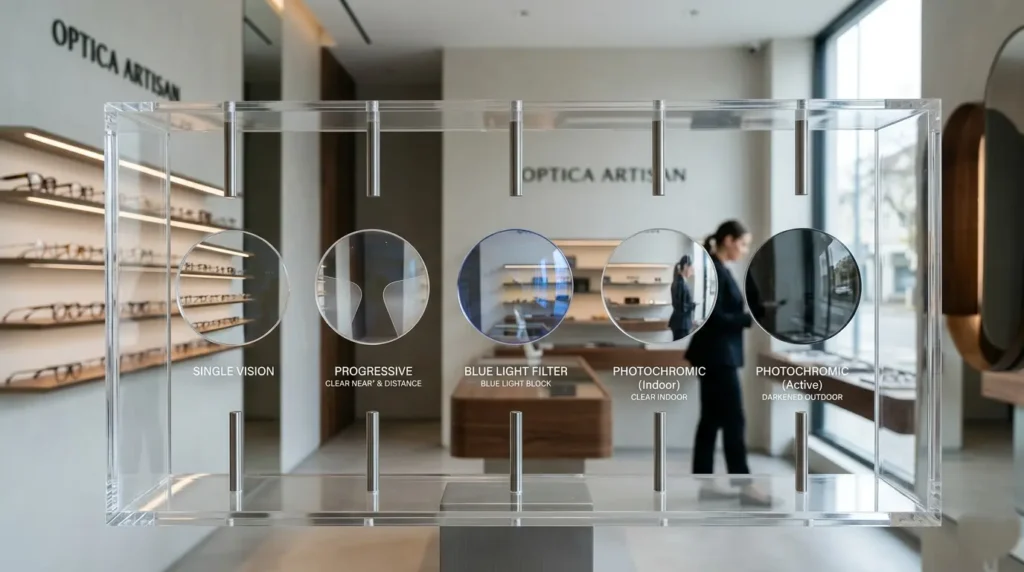
Walk into any optical store and you’ll quickly realise — choosing a pair of glasses involves far more than picking a frame shape you like. The lenses sitting inside that frame are what actually do the work. They determine how clearly you see, how comfortable your eyes feel by the end of the day, and how well your glasses hold up over time.
The best types of lenses for glasses depend on your prescription, your lifestyle, and the kind of vision correction you need. With so many different types of optical lenses for glasses available today, it helps to understand what each one does before you decide. We’ve put this guide together to walk you through every key category — from vision correction types and lens materials to coatings and tints — so your next pair of glasses is one you’ll genuinely enjoy wearing.
Table of Contents
Understanding Your Prescription
Your prescription is the starting point for every lens decision. It includes values for sphere (SPH), cylinder (CYL), and axis — these tell your optician whether you’re dealing with myopia (nearsightedness), hyperopia (farsightedness), astigmatism, or a combination.
A few common refractive errors worth knowing:
- Myopia — Light focuses in front of the retina, making distant objects blurry while near vision stays clear
- Hyperopia — Light focuses behind the retina, making near objects blurry while distance vision remains clearer
- Astigmatism — An irregularly shaped cornea causes light to land at multiple points, making vision blurry at various distances
- Presbyopia — An age-related condition (typically beginning around age 40) where the eye’s lens gradually stiffens, making it harder to focus on close objects
If your prescription includes an ADD value, it means you need different correction strengths for near and distance vision — this usually points toward multifocal lenses. A prism value, if present, addresses a different kind of issue altogether, which we cover separately below.
Types of Eyeglass Lenses for Vision Correction
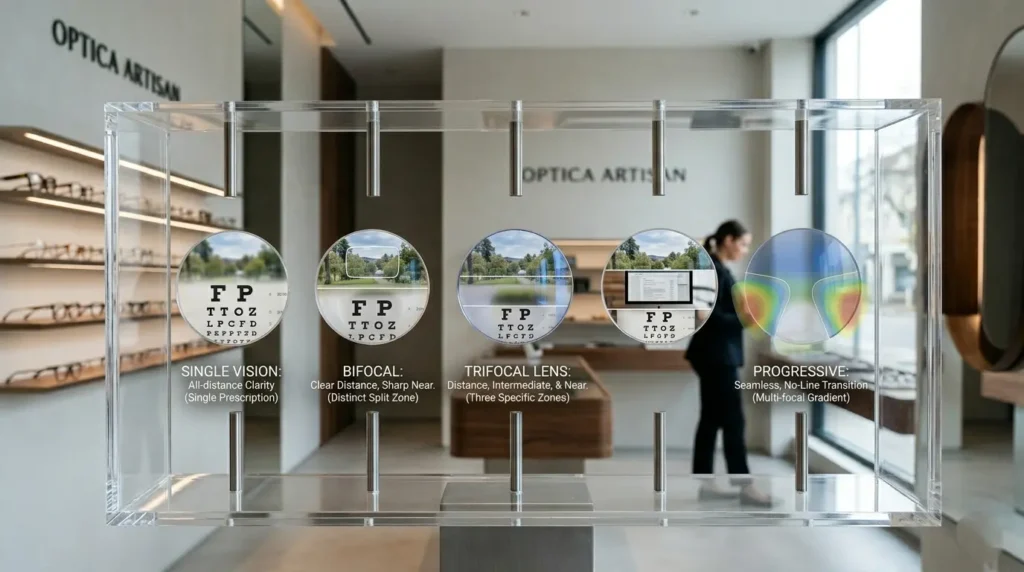
Single Vision Lenses
Single vision lenses carry one prescription across the entire lens surface. They correct for one field of vision — either distance, intermediate, or near — and are the most commonly prescribed spectacle lens type. Because the full lens shares the same power, they offer a wider, more natural field of view than multifocal lenses. They work well for myopia, hyperopia, and astigmatism, and are the most straightforward, cost-effective starting point.
Bifocal Lenses
Bifocals contain two distinct prescription zones separated by a visible horizontal line. The upper portion handles distance vision; the lower section is set for near vision. They’re commonly prescribed when someone needs both distance correction and near correction for presbyopia. The trade-off is the visible line, which some people find distracting or aesthetically undesirable.
Trifocal Lenses
Trifocals add a third zone for intermediate distances — typically arm’s length — with two visible dividing lines across the lens. They suit people who spend significant time at a screen or doing tasks at mid-range distances. While progressives have largely replaced trifocals for most wearers, they remain a practical option in certain occupational settings where distinct zone clarity is preferred.
Progressive Lenses
Progressive lenses — also called varifocals or no-line multifocals — offer a seamless gradient across three focal zones: distance at the top, intermediate in the middle, and near vision at the bottom. There are no visible lines. The transition between zones is smooth, making them the most natural-looking and natural-feeling multifocal option.
Key things to know before choosing progressives:
- An adjustment period of one to two weeks is normal as your eyes learn to find and use each zone
- Slight peripheral distortion is common initially and typically settles with consistent wear
- They’re priced higher than bifocals or trifocals but eliminate the need for multiple pairs
- Research suggests multifocal lenses including progressives may also help slow myopia progression in some children
Anti-Fatigue Lenses
Anti-fatigue lenses are built on a single vision prescription with a small added zone of magnification at the bottom of the lens. This lower area relaxes the eye muscles responsible for close focus, reducing the strain that builds up during prolonged screen use, reading, or detailed near work. They’re an excellent middle-ground option for people who don’t yet need full progressives but find their eyes tiring by the end of a screen-heavy day.
Prism Lenses
When the two eyes don’t move in alignment — a condition known as binocular vision dysfunction — symptoms like double vision, persistent headaches, or eye strain can develop. Prism lenses are prescribed specifically to redirect light before it enters the eye, helping both eyes work together correctly. The prism correction is incorporated into the lens at a precise position and orientation, measured in prism diopters. These lenses correct alignment issues but cannot address refractive errors on their own; they’re typically combined with a standard prescription.
Types of Glasses Lens Materials
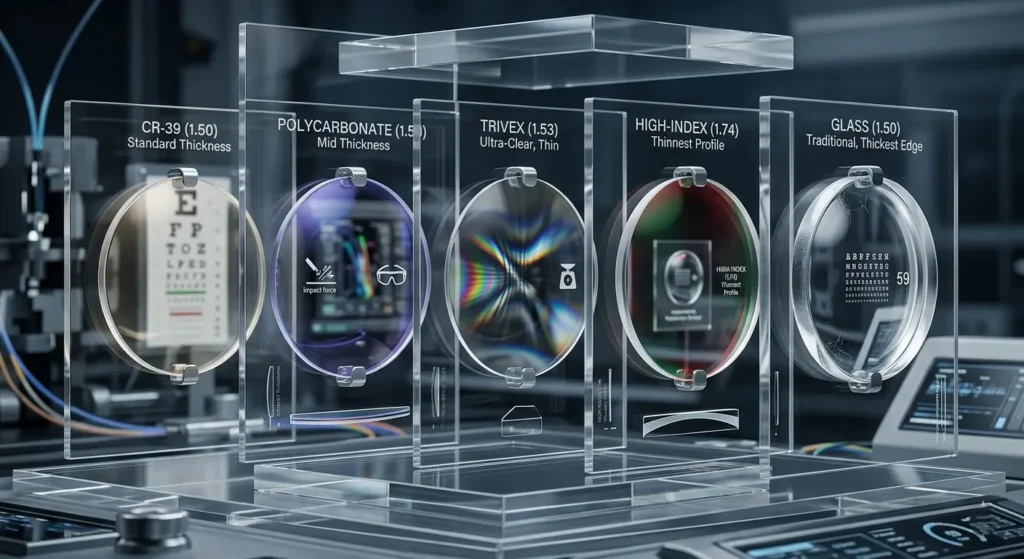
Lens material affects weight, thickness, optical clarity, durability, and how well the lens performs at your prescription strength. Two technical properties help explain the differences.
Refractive Index
The refractive index measures how efficiently a material bends light. A higher number means the lens can be made thinner while delivering the same corrective power. For strong prescriptions, a higher refractive index makes a visible, noticeable difference in how slim and light the lens feels.
Abbe Value
The Abbe value measures chromatic aberration — how much a material disperses light into its colour components when viewed through the edges of a lens. A low Abbe value can produce colour fringes or subtle halos around objects. A higher Abbe value means cleaner, clearer vision with less edge distortion. This is an important trade-off to understand: high-index materials offer thinner lenses but often come with lower Abbe values.
Material Comparison
| Material | Refractive Index | Abbe Value | Density | Best For |
|---|---|---|---|---|
| Crown Glass | 1.523 | 58 | 2.54 | Optical clarity; rarely used today |
| CR-39 Plastic | 1.499 | 58 | 1.32 | Mild to moderate prescriptions; everyday clarity |
| Polycarbonate | 1.586 | 30 | 1.20 | Children, sports, active lifestyles; built-in UV |
| Trivex | ~1.53 | ~45 | ~1.11 | Clarity + durability; lighter than polycarbonate |
| High-Index Plastic | 1.60–1.74 | 32–40 | 1.35–1.47 | Strong prescriptions (+/-4.00 and above) |
A few notes worth keeping in mind:
- CR-39 plastic and crown glass share the highest Abbe value (58) of any common lens material — meaning the least chromatic aberration and the cleanest optical clarity, especially at the lens edges
- Polycarbonate’s Abbe value of 30 is the lowest in the table, but its impact resistance, built-in UV protection, and lightweight nature make it the most widely recommended everyday material
- Trivex sits between polycarbonate and CR-39 — it’s lighter than polycarbonate, has a better Abbe value, and maintains impact resistance, but costs more
- High-index lenses trade some optical clarity (lower Abbe values) for the significant benefit of thinness and lightness at high prescription powers
Types of Lens Coatings and Treatments
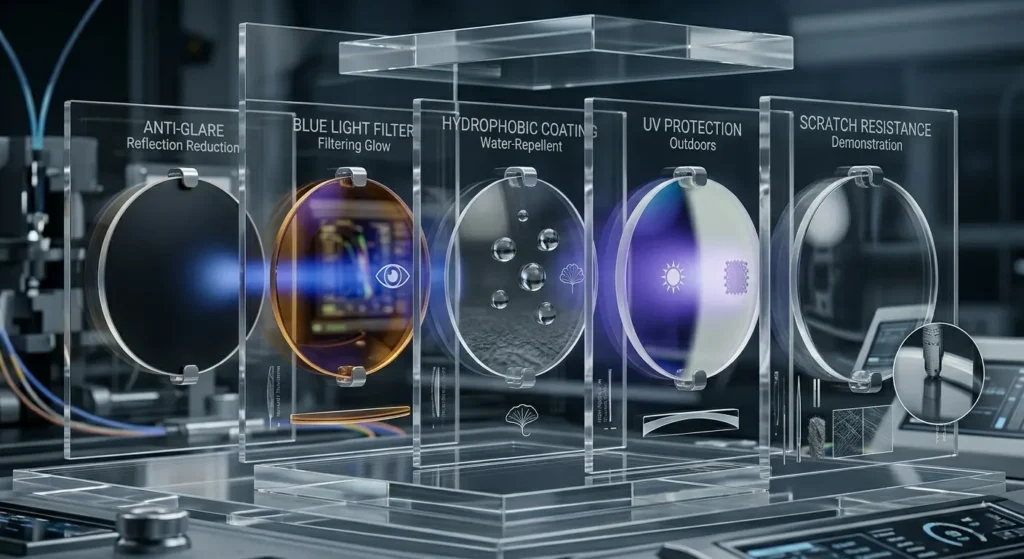
Coatings are applied to the lens surface to enhance performance, extend lifespan, and protect your eyes. Many quality lenses come with core coatings built in; others are available as optional add-ons.
- Scratch-resistant coating — Hardens the lens surface to protect against everyday abrasions. Extends lens lifespan and keeps vision clear. Especially important for CR-39 plastic, which is more susceptible to surface scratching
- Anti-reflective (AR) / anti-glare coating — Applied to both front and back surfaces of the lens, this reduces reflections and glare from screens, headlights, and artificial lighting. It also increases the amount of light transmitted through the lens for sharper detail. Particularly important for high-index lenses, which naturally reflect more light
- UV protection — Blocks UVA and UVB rays from reaching the eye. Polycarbonate lenses have this built in; other materials require it as an applied coating. Cumulative UV exposure is linked to increased risk of cataracts and macular degeneration, so this is a non-negotiable for outdoor use
- Blue-violet light filtering — Filters high-energy wavelengths (approximately 400–495 nm) from digital screens, artificial lighting, and sunlight. Often paired with AR coating for screen-heavy users
- Photochromic treatment — Lenses darken automatically when exposed to UV light outdoors and return to clear indoors. Provides close to 100% UVA and UVB protection and removes the need for a separate pair of prescription sunglasses
- Polarised treatment — A film inserted into the lens material that filters horizontally reflected light — the glare that bounces off water, snow, roads, and flat surfaces. Improves contrast, reduces squinting, and enhances visual clarity in bright outdoor conditions
- Hydrophobic / anti-smudge coating — Repels water, oil, and dust so lenses stay cleaner for longer and are easier to wipe without streaking
- Light sensitivity tint — A tinted coating ranging from pink to amber to grey, used to filter light for people with photophobia (light sensitivity). Improves visual comfort in bright environments
Lens Tints
Tints filter specific parts of the light spectrum and serve both functional and aesthetic purposes. In sunglasses, all lenses carry a tint; in everyday glasses, tints can be added for specific visual needs.
| Tint Colour | Key Benefit | Best Suited For |
|---|---|---|
| Grey | Preserves natural colour accuracy; reduces brightness | Everyday outdoor use; driving |
| Brown / Amber | Enhances contrast and depth perception; reduces digital glare | Driving, outdoor sports, screen use |
| Yellow / Orange | Improves visual clarity in low light and overcast conditions | Skiing, shooting sports, night driving |
| Green | Reduces glare while maintaining colour contrast | Versatile indoor and outdoor use |
| Pink / Rose | Increases depth perception; eases strain for light-sensitive users | Screen use, photophobia, driving |
| Blue | Reduces some glare; primarily aesthetic | Style-led choice |
Mirrored lenses add a reflective coating over a tinted base, providing extra protection from intense light while giving sunglasses their characteristic reflective finish.
How to Choose the Right Lenses for You
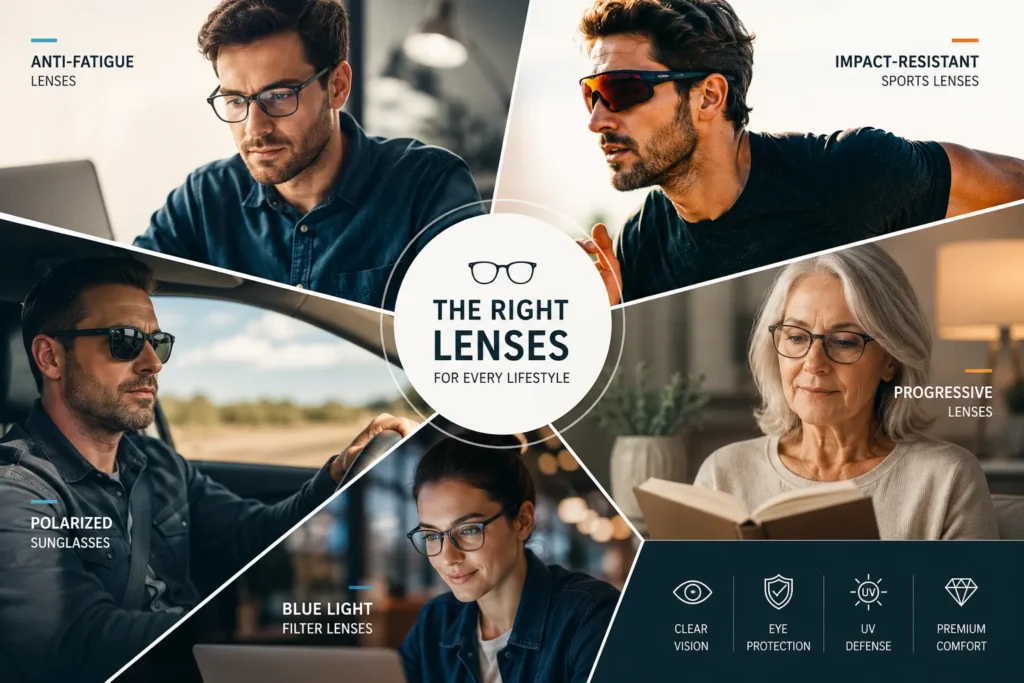
The best lenses for glasses are the ones that match both your prescription and your daily life. Here’s a practical breakdown by lifestyle:
Basic prescription, one distance to correct → Single vision lenses in polycarbonate or CR-39 — simple, affordable, and effective
Need correction at multiple distances → Progressive lenses for a seamless, line-free experience; bifocals if simplicity and cost are the priority
Strong prescription (+/-4.00 or higher) → High-index lenses (1.67 or 1.74) for noticeably thinner, lighter glasses
Active lifestyle, sports, or glasses for a child → Polycarbonate or Trivex for impact resistance and built-in UV protection
Experiencing eye fatigue or strain from screens → Anti-fatigue lenses with AR coating and blue-violet light filtering
Moving frequently between indoors and outdoors → Photochromic lenses eliminate the need for a separate pair of sunglasses
Driving regularly or spending time near water, snow, or open roads → Polarised lenses for glare reduction and sharper visual contrast
Double vision, persistent headaches, or eye alignment issues → Discuss prism lenses with your eye doctor — they’re more commonly needed than most people realise
When comparing options, your optician is your best resource. Bring your lifestyle into the conversation, not just your prescription numbers. The four factors worth keeping in mind at any decision point: vision correction, eye safety, visual comfort, and aesthetics.
In Summary
- The main types of eyeglass lenses — single vision, bifocal, trifocal, progressive, anti-fatigue, and prism — each address specific vision conditions and daily use patterns
- Lens material determines thickness, weight, and clarity; polycarbonate leads for everyday durability, Trivex for a clarity-durability balance, high-index for strong prescriptions
- Refractive index governs how thin a lens can be; Abbe value governs optical clarity — both matter when comparing materials, especially at higher prescription strengths
- CR-39 plastic and crown glass offer the best Abbe value (58) of any common material; polycarbonate trades that for superior impact resistance and built-in UV protection
- Coatings like AR, UV protection, scratch resistance, and blue-violet filtering add real, everyday value and are worth choosing from the start rather than upgrading later
- Lens tints serve functional purposes beyond aesthetics — brown for contrast, yellow for low-light clarity, grey for neutral outdoor use
- Always match your lens to both your prescription strength and your routine — not one without the other
- At Intersellermart, we offer a wide range of eyewear designed for real vision needs. Explore our collection at shop.intersellermart.com and find lenses that work as hard as you do
Frequently Asked Questions
What is the difference between polycarbonate and Trivex lenses? Both are impact-resistant and lightweight, but they differ in optical clarity and thickness at higher prescriptions. Trivex has a significantly higher Abbe value (~45 vs 30 for polycarbonate), meaning less chromatic aberration and cleaner edge-to-edge clarity. However, Trivex lenses become thicker than polycarbonate at prescriptions above approximately +/-3.00, and they cost more. For most everyday wearers, polycarbonate is the practical choice; for those who prioritise optical clarity over price, Trivex is worth considering.
Are progressive lenses suitable for first-time glasses wearers? Yes — and in many cases, first-time wearers adapt more easily than those switching from bifocals or trifocals, since they have no prior lens habits to unlearn. The key is wearing them consistently from day one. Most people adjust fully within one to two weeks. If dizziness or distortion persists beyond three weeks, return to your optician, as a fitting or prescription adjustment may be needed.
Do all lenses come with UV protection? Not automatically. Polycarbonate lenses have UV protection built into the material itself. CR-39 plastic naturally blocks up to 80% of UV light, but a full UV coating offers more complete protection. Glass and high-index lenses require UV coating to be specifically applied. When choosing lenses, always confirm whether UV protection is included — it’s one of the most important long-term safeguards for eye health.
What does the Abbe value actually affect in everyday wear? The Abbe value affects how much chromatic aberration you see — particularly colour fringing or subtle halos around objects when looking through the edges of the lens rather than the centre. At lower prescription strengths, a low Abbe value rarely causes noticeable issues. At stronger prescriptions, or when the eyes move to the lens periphery often, a low Abbe value (like polycarbonate’s 30) can cause mild visual disturbance. If you’re sensitive to this, a material with a higher Abbe value — such as Trivex or CR-39 — is worth the discussion with your optician.
Can I get coatings added to lenses I already own? No — coatings are applied during the manufacturing process and cannot be retrofitted to existing lenses. If you want to upgrade to anti-reflective, blue-violet filtering, or hydrophobic coatings, new lenses need to be made. This is why it’s more cost-effective to choose your full coating combination upfront rather than returning for an upgrade later.
How often should eyeglass lenses be replaced? Lenses should be replaced whenever your prescription changes significantly, or when they show visible wear — deep scratches, coating breakdown, or persistent cloudiness that affects vision. Even with a stable prescription, most eye care professionals recommend a comprehensive eye check every one to two years to confirm your correction is still accurate. Lens coatings typically degrade over two to three years with daily use, which is another practical reason to replace lenses periodically even when the prescription hasn’t changed.