
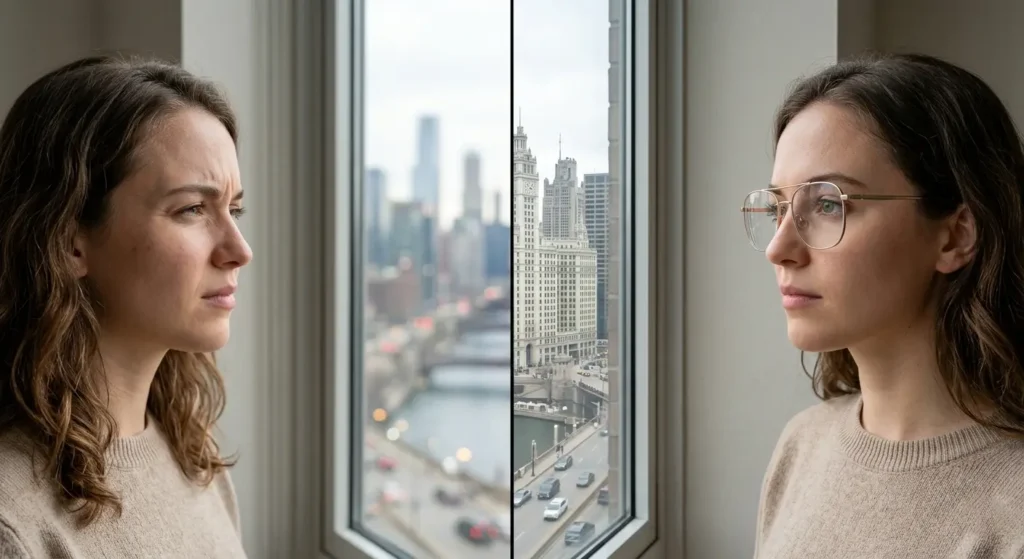
Let me guess.
You’ve been wearing glasses for a while now, and every time you take them off — the world looks blurrier than you remember it being before you got them. And somewhere in the back of your mind, a little voice whispers: “Are these actually making things worse?”
Or maybe you’re in the opposite camp. You’ve been putting off getting glasses for months, hoping your eyes will sort themselves out. Someone told you that once you start wearing glasses, you’ll never be able to stop. So you’re squinting through meetings, sitting closer to the TV than you’d like to admit, and telling yourself it’s fine.
Here’s the thing — both of those concerns are completely understandable. And both of them are largely based on myths that have been circulating for so long that they feel like facts.
So let’s answer the real question that’s been nagging at you: can wearing glasses improve eyesight? Not the vague, hedging answer you get from a quick Google search. The actual, clear, honest answer — with the reasoning behind it so you genuinely understand what’s happening with your eyes.
Table of Contents
Before We Answer: Understanding What’s Actually Happening in Your Eye

You can’t properly answer the question of can wearing glasses improve eyesight without first understanding how vision works — and more importantly, why it sometimes doesn’t.
Your eye functions a bit like a camera. Light enters through the cornea (the clear dome at the front of your eye), passes through the lens, and needs to land precisely on the retina at the back to create a sharp image. When the shape of your eye is perfectly suited to this task, everything is crisp and clear without any help.
But for a huge number of people, that shape is just slightly off. The eyeball might be a touch too long, a touch too short, or the cornea might curve unevenly. When that happens, light focuses in the wrong place — and you get blurry vision. This is what eye care professionals call a refractive error.
The three most common refractive errors you’ve probably heard of are:
- Myopia (nearsightedness): Your eyeball is too long, so light focuses just in front of the retina instead of on it. Distant things look blurry; close things are usually fine.
- Hyperopia (farsightedness): Your eyeball is too short, so light tries to focus behind the retina. Near vision suffers, and in some cases distance vision does too.
- Astigmatism: Your cornea is irregularly curved, so light scatters across multiple focal points rather than one. This causes blurry vision at all distances.
What glasses do is step in and correct that misdirected light before it reaches your eye. The lenses in your frames are precisely shaped to redirect incoming light so it lands exactly where it should on your retina. The result is instant, clear vision.
The crucial part: glasses are adjusting light. They are not reshaping your eye, not treating the underlying condition, not curing anything. When you take them off, your eyes return to exactly their natural state — because the glasses were never changing the eye itself.
So, Can Wearing Glasses Improve Eyesight? Here’s the Real Answer

Let’s be direct about this, because wearing glasses improves eyesight deserves a clear answer rather than a wishy-washy one.
Yes — and also no. And understanding which is which actually matters.
Wearing glasses improves your vision immediately and dramatically while you have them on. That improvement is absolutely real. You go from squinting and straining to seeing the world in sharp, comfortable detail. That’s not nothing — that’s huge.
But glasses do not permanently improve your eyesight — meaning they don’t alter the underlying physical structure of your eye or correct the refractive error itself. When you remove them, your uncorrected vision is exactly as it was before.
So the answer to whether wearing glasses improves eyesight depends on what you mean by “improve.” If you mean clarity of vision while wearing them — absolutely yes. If you mean permanently fixing the eye — no, not in most cases.
Think of it this way. A hearing aid dramatically improves your ability to hear. But when you take it out, your hearing returns to its natural state. The device wasn’t healing your ear — it was compensating for it. Glasses work the same way. They’re one of the most brilliant compensatory tools ever invented, but they’re a tool — not a treatment.
There are exceptions to this, though, and they’re worth knowing about.
When Glasses Actually Do Improve Eyesight Long Term

Here’s where the answer to can wearing glasses improve eyesight becomes genuinely more interesting.
In Children With Lazy Eye (Amblyopia)
Amblyopia — commonly called lazy eye — happens when one eye has a significantly stronger refractive error than the other, causing the brain to favour the stronger eye and essentially “tune out” the weaker one. Over time, the visual pathways connected to the weaker eye stop developing properly.
Left untreated during childhood, this leads to permanently reduced vision in that eye — not because the eye itself is damaged, but because the brain never learned to use it properly.
Glasses — especially when combined with patching therapy — actively retrain the brain to use the weaker eye. In this case, wearing glasses genuinely improves eyesight in a lasting way. The visual development that happens during treatment doesn’t disappear when the glasses come off. This is why skipping glasses in children with amblyopia can cause irreversible vision loss, and why eye care professionals take children’s eyewear so seriously.
In Children With Rapidly Progressing Myopia
Research shows that children with myopia who consistently wear the right correction may experience slower deterioration than those who don’t. Clinical studies on specialised lenses have shown they can slow the rate of myopia progression by around 50% in kids between the ages of 6 and 16. Myopia control glasses — specifically designed to manage how the eye develops — represent one of the clearest cases where glasses can genuinely influence the future trajectory of someone’s eyesight.
Reducing Long-Term Eye Strain Damage
This one doesn’t change your refractive error, but it has a profound effect on how your eyes feel and function over time. When you wear the right glasses, your eye muscles aren’t grinding away all day trying to compensate for what they can’t do alone. The headaches ease up. The afternoon eye fatigue reduces. As one ophthalmologist puts it, wearing corrective lenses puts less strain on your eyes and leaves them more rested and comfortable. Over months and years, that reduction in constant strain has real, compounding benefits for your overall eye health and comfort.
The Myth That Won’t Die: “Glasses Make Your Eyes Weaker”

It’s time to properly bury this one, because it does genuine harm every single day.
The fear sounds logical on the surface: “I started wearing glasses. A few years later, I needed a stronger pair. Therefore, the glasses made my vision worse.”
The logic is wrong. The timeline is real — but the cause isn’t.
Your eyeglass prescription may change because your eyes and your vision naturally change as you age. Most of your eye growth happens in childhood and adolescence, and as you get older, your vision continues to change even as the shape of your eye remains the same. That’s happening whether you wear glasses or not. The glasses are responding to those changes — not causing them.
Many people assume their glasses are causing their eyesight to decline, but the reality is that vision naturally changes with age. Myopia, hyperopia, and other conditions all progress over time, with or without glasses.
The other piece of the puzzle is perception. Before you had glasses, your brain was accustomed to blurry vision. It had normalised the struggle. Once you start wearing the right correction consistently, your brain recalibrates to what clear vision actually feels like. When you then take your glasses off, the contrast is startling — but nothing has actually changed. Your brain has just gotten used to seeing well, so the effects of uncorrected vision feel more noticeable than before.
A study found that a staggering 75.2% of people fear becoming permanently dependent on glasses — but that “dependence” is simply your brain refusing to go back to straining once it knows what comfortable vision feels like. That’s not deterioration. That’s just having higher standards for how you see the world.
Does Not Wearing Glasses Make Your Eyes Worse?

This is closely related to the dependency myth and equally worth addressing.
Not wearing your glasses will strain your eyes and tire them out, but it will not worsen your vision or lead to eye disease. In other words — skipping your glasses won’t permanently damage your refractive error or accelerate its progression in adults.
What it will do is make your eyes work significantly harder than they need to. That constant straining to focus causes fatigue, headaches, difficulty concentrating, and general eye discomfort. None of these are dangerous long-term — but none of them are pleasant either, and there’s genuinely no reason to put yourself through it.
For children, the stakes are meaningfully higher. In kids with conditions like amblyopia or significant refractive errors, not wearing glasses when advised can interfere with healthy visual development during the critical window of childhood — and that can have lasting consequences.
What Actually Causes Your Vision to Get Worse Over Time?

Since glasses themselves aren’t to blame, what is actually causing your vision to change as the years go by?
Age. The lens inside your eye stiffens naturally as you get older, making it harder to shift focus between near and far distances. This process, called presbyopia, typically becomes noticeable in your early 40s and is completely unrelated to whether you’ve worn glasses your whole life or never worn them at all.
Genetics. Family history is one of the strongest predictors of whether you’ll develop myopia, hyperopia, or astigmatism. If both of your parents wear glasses, there’s a meaningful chance you will too — and that trajectory is largely independent of your eyewear habits.
Extended near work and screen time. Prolonged close-up activity — reading, studying, and especially heavy screen use — is strongly associated with the development and progression of myopia, particularly in children and young adults. This isn’t caused by glasses. It’s caused by the visual activity itself, and it’s worth taking seriously given how screen-heavy modern daily life has become.
Lack of outdoor time. Research consistently shows that children who spend more time outdoors tend to have slower myopia progression. Natural light exposure plays a role in healthy eye development that indoor environments simply can’t replicate.
Overall health. Conditions like diabetes and high blood pressure can affect the blood vessels in your eyes and change your vision over time. This is one of the reasons regular eye check-ups are valuable beyond just updating your glasses — they can catch signs of systemic health conditions early.
What You Can Actually Do to Support Your Eye Health

Understanding that wearing glasses improves eyesight temporarily while you wear them also points toward what you can realistically do beyond just wearing the right glasses.
Follow the 20-20-20 rule – seriously. Every 20 minutes of screen time or close work, look at something at least 20 feet away for 20 seconds. It takes 10 seconds to do and physically relaxes the focusing muscles in your eyes. Over a long workday, this habit makes a compounding difference in how tired your eyes feel by evening.
Wear blue light filtering glasses for screen use. If you spend significant hours on digital devices, blue light filtering lenses reduce eye fatigue, ease digital eye strain, and — because blue light suppresses melatonin — wearing them in the evening can meaningfully improve your sleep quality. Better sleep means better everything, including less eye fatigue the next day.
Wear UV protection glasses outdoors. Prolonged UV exposure contributes to cataracts and macular degeneration over time. Quality sunglasses with UV400 protection are as important for your long-term eye health as your everyday glasses are for your daily vision comfort.
Eat for your eyes. Certain nutrients actively support eye health in measurable ways. Lutein and zeaxanthin — found in leafy greens like spinach and kale — protect the retina from damage. Vitamin C and E are antioxidants that support lens health. Omega-3 fatty acids from fish like salmon help reduce dry eye symptoms and support the tear film that keeps your eyes comfortable. These aren’t miracle cures, but they’re real contributions to long-term eye health.
Keep your eyes moist. Screen time significantly reduces how often you blink — sometimes by up to 60%. Fewer blinks means less natural lubrication for your eyes, which leads to dryness, irritation, and fatigue. Blinking deliberately and consciously during screen sessions, and keeping your environment from getting too dry, makes a real difference.
Get regular eye check-ups. Vision changes gradually — often so gradually that you adapt without realising how much your clarity has shifted. Regular eye exams catch those changes early, ensure your correction is always matched to your current eyes, and screen for conditions like glaucoma, cataracts, and early macular degeneration that don’t always announce themselves with obvious symptoms. Catching these early matters enormously for outcomes.
Myths About Glasses — Let’s Just Clear All of These Up

Since we’re here, let’s knock out a few other myths that keep circulating:
“Reading in dim light ruins your eyesight.” It makes your eyes work harder and tires them out faster. But according to Harvard Health, dim lighting does not actually damage your eyesight or eye health. Uncomfortable, yes. Damaging, no.
“Eye exercises can fix your refractive error.” There is no scientific evidence that eye exercises correct myopia, hyperopia, or astigmatism. Your vision depends on the shape of your eyeball and the health of eye tissues, neither of which can be significantly altered with eye exercises. They may help with eye strain and muscle flexibility, but they cannot change the physical structure of your eye.
“Not wearing glasses lets your eyes rest and recover.” The opposite is true. Not wearing your glasses strains your eyes and tires them out instead of resting them. Your eyes are doing extra work to compensate for the refractive error without any help. That’s not rest — that’s overtime.
“Children will become too dependent on glasses.” This fear causes real harm. For children who need glasses — especially those with amblyopia or significant refractive errors wearing the right correction during the critical years of visual development is essential. Withholding glasses to avoid “dependency” can cause permanent vision impairment that no amount of glasses later in life can fully reverse.
(FAQs)
Q: Can wearing glasses improve eyesight permanently? Wearing glasses dramatically improves your vision while you’re wearing them — and that’s genuinely valuable. But they don’t permanently alter your eye’s structure or fix the refractive error. The exception is children with conditions like amblyopia, where glasses can contribute to real, lasting visual development during childhood.
Q: Does not wearing glasses make your eyes worse over time? In adults, skipping glasses doesn’t worsen your refractive error, but it does cause eye strain, headaches, and fatigue from the constant effort of trying to compensate. For children with certain conditions, not wearing glasses when advised can lead to permanent vision impairment.
Q: Why does everything look blurrier when I take my glasses off? Because your brain has adjusted to seeing clearly. Before glasses, blurry vision was your normal, so you barely noticed it. Once your brain experiences consistent clarity, the contrast when you remove your glasses feels dramatic — but your actual uncorrected vision hasn’t changed. Your standards have simply been raised.
Q: Do glasses weaken your eye muscles? No. Your eye muscles control movement — looking up, down, sideways. Glasses work with your eye’s optical system, not its muscles. There is no mechanism by which glasses could weaken your eye muscles.
Q: Are there natural ways to improve eyesight without glasses? For established refractive errors, no natural method has been proven to correct the underlying structure. Healthy habits — good nutrition, time outdoors, screen breaks, adequate sleep — genuinely support eye health and may slow progression, but they can’t reverse an existing refractive error without surgical intervention.
Q: Can wearing glasses improve eyesight in children? In children with amblyopia or certain developmental vision conditions, yes — glasses can genuinely improve and support healthy visual development in ways that last. For standard refractive errors, glasses improve vision clarity daily but don’t permanently alter the eye structure.
Q: Do blue light glasses actually help your eyes? Blue light filtering glasses reduce digital eye strain and eye fatigue during long screen sessions, and help regulate sleep by reducing blue light exposure in the evening. They don’t correct refractive errors, but for screen-heavy lifestyles they offer real day-to-day comfort benefits.
The Bottom Line

So — can wearing glasses improve eyesight?
Here’s the complete, honest answer: Glasses give you dramatically better vision the moment you put them on. They reduce the chronic strain your eyes have been fighting through. They prevent headaches, squinting, and fatigue. In children with certain conditions, they genuinely improve and shape how eyesight develops — with lasting results. And when paired with the right habits and lens features, they actively support your long-term eye health in ways that go well beyond just “helping you see.”
What glasses don’t do is permanently reshape your eye or cure the refractive error. When you take them off, your natural vision is exactly where it was. That’s not a failure — that’s just how optics work. And it doesn’t make glasses any less valuable.
Stop second-guessing whether you should be wearing your glasses. Stop worrying that they’re making your eyes lazy or dependent. That worry is a myth, and myths like that have been causing people to strain their eyes unnecessarily for decades.
Your vision is worth taking care of — with the right eyewear, the right habits, and an honest understanding of what your glasses are actually doing for you.
Explore our full range of everyday glasses and eyeweahttps://shop.intersellermart.com/product-category/optical-frames/r – designed for all-day comfort, clear vision, and styles that actually suit how you live.
Have a question about eyewear or eye health that we didn’t cover here? Drop it in the comments — we read every single one and we’d love to help.
From SEO to paid ads, we help eCommerce eyewear brands build visibility and drive consistent sales at InterSellerMart
Write more, thats all I have to say. Literally, it seems as though you relied on the video to make your point.
You clearly know what youre talking about, why waste your intelligence on just posting videos to your weblog when you could be giving
us something informative to read?