

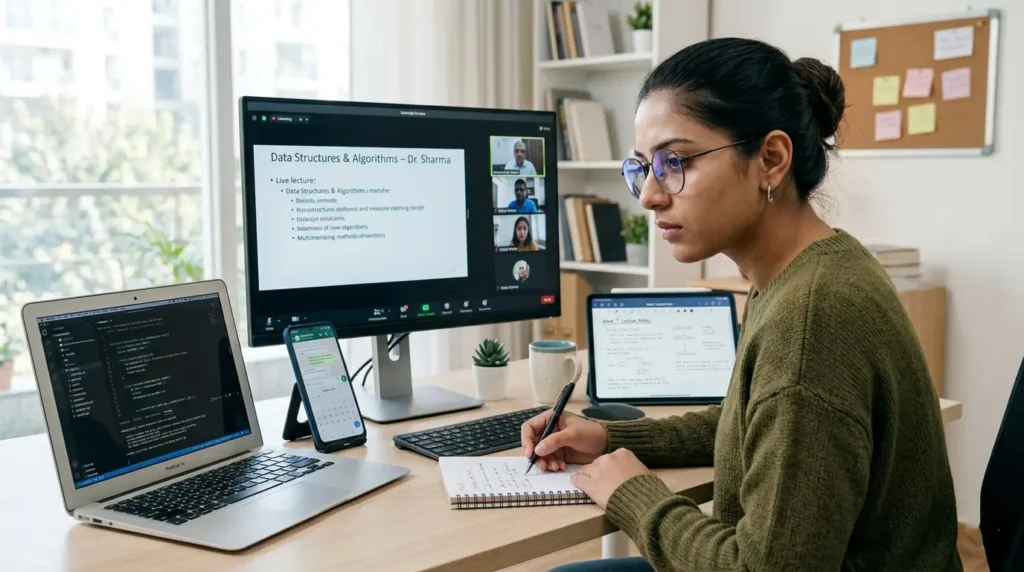
It’s 11:30 PM. Exam in the morning. Your notes are open, three different YouTube explanation videos are paused mid-screen, and your WhatsApp study group is blowing up with panicked messages. You’ve been staring at your laptop since 6 PM and your eyes feel like someone’s slowly squeezing them from the inside.
You blink hard. Twice. Three times. The blur doesn’t really go away.

If that sounds like a Tuesday for you — welcome to being a student in India in 2026. Screens aren’t just part of student life anymore. They basically are student life. Online lectures. Digital textbooks. Zoom doubt sessions. Mock test portals. Reels at 2 AM when your brain refuses to sleep. It’s all screens, all the time.
And while we’ve all just kind of accepted this as normal, our eyes absolutely have not.
The good news is that the right pair of eyeglasses can genuinely help. Not fix everything — but make a real, noticeable difference in how your eyes feel by the end of a long study day. The trick is knowing what to actually look for, because most students either buy whatever’s cheapest or whatever looks coolest — and both approaches can quietly make things worse.
So here’s a proper, no-fluff guide to finding the best eyeglasses for students in India — features, frames, budget tips, and the stuff nobody usually tells you.
Table of Contents
First, Let’s Talk About What’s Actually Happening to Your Eyes

Before getting into what to buy, it helps to understand why your eyes are suffering in the first place.
A typical Indian student today spends somewhere between 6 to 10 hours on digital devices. Lectures, studying, scrolling, gaming — it adds up fast. And every single one of those hours, your eyes are being hit by blue light — a high-energy visible (HEV) light emitted by every screen, LED classroom light, and tube light around you.
Blue light itself isn’t some sci-fi villain, but prolonged exposure to it does two things that seriously affect students. First, it strains your eye muscles, because your eyes have to work harder to process high-energy light over long periods. This is what causes that burning, tired, heavy feeling by evening. Second — and this one really hurts students — blue light suppresses melatonin, the hormone that makes you sleepy at the right time. So your body’s already confused about when to sleep, and staring at screens until midnight makes it ten times worse.
The result is a cycle most students know painfully well: tired eyes → can’t focus → study less effectively → stress → stay up later → even more screen time → worse sleep → wake up exhausted → repeat.
The right eyewear won’t fix your entire routine. But it’s a genuinely useful tool in breaking that cycle — and finding the best eyeglasses for students in India is more straightforward than most people think.
What to Actually Look for — Features That Make a Real Difference

Let’s cut past the marketing language and talk about what actually matters in student eyeglasses.
Blue Light Blocking Lenses — This Is the Big One
For students, this is the most important feature by a significant margin. Blue light blocking lenses have a special coating that filters out a portion of the high-energy blue light coming from your screen before it reaches your eyes. The reduction in eye strain is real and noticeable — especially after 4–5 hour study sessions.
Look for lenses that block at least 30–50% of blue light. Anything less and you’re basically paying for a regular lens with a faint yellow tint. Anything more and colors might start looking slightly off on your screen — not ideal when you’re staring at diagrams and PDFs all day.
Here’s a useful thing to know: you don’t need to be wearing these only when you’re studying. Blue light blocking glasses are safe to wear all day, and many students just keep them on from morning to night. The lenses look completely clear and normal — nobody can even tell the difference.
Anti-Glare Coating — The One Everyone Skips and Then Regrets
Anti-glare (or anti-reflective) coating is one of those things you don’t notice when you have it, but absolutely notice when you don’t. Without it, every tube light, laptop screen reflection, and sunny window in your classroom becomes a tiny distraction that your eyes keep fighting against, hour after hour.
For students in India who move between hostels, classrooms, college canteens, and outdoor spaces multiple times a day, the lighting conditions are constantly changing. Anti-glare coating helps your eyes adapt to all of that without working overtime.
It’s usually a small add-on cost when buying online. Just get it. You’ll thank yourself three weeks into the semester.
Lightweight Frames — More Important Than You Think

Here’s something that sounds minor until it isn’t: heavy glasses are exhausting to wear all day.
After six hours of classes and four more hours of studying, a frame that presses even slightly too hard on your nose or temples goes from a minor annoyance to a genuine headache — literally. Students often blame these headaches on stress or screen fatigue, when sometimes it’s just the frame pressing on a nerve all day.
The materials to know about are:
TR90 — This is the gold standard for student frames. It’s a thermoplastic material — ultra-light, flexible, and surprisingly tough. TR90 frames can bend pretty dramatically without snapping, which matters when your bag gets overstuffed with books and your glasses take the brunt of it. Most affordable online frames are TR90 for good reason.
Metal (stainless steel or titanium) — Sleek, minimal, and durable. Titanium is the premium version — extremely light, rust-proof, and hypoallergenic. Great if you have sensitive skin where nose pads sit. Metal frames give a more professional, clean aesthetic that works well from the classroom to an internship.
Acetate — A plant-based plastic that’s a little heavier than TR90 but offers a much richer range of colors, patterns, and textures. If you want your frames to be a style statement — bold colors, tortoise shell, transparent finishes — acetate is where the fun lives.
Durability — Because Student Life Is Genuinely Rough on Glasses

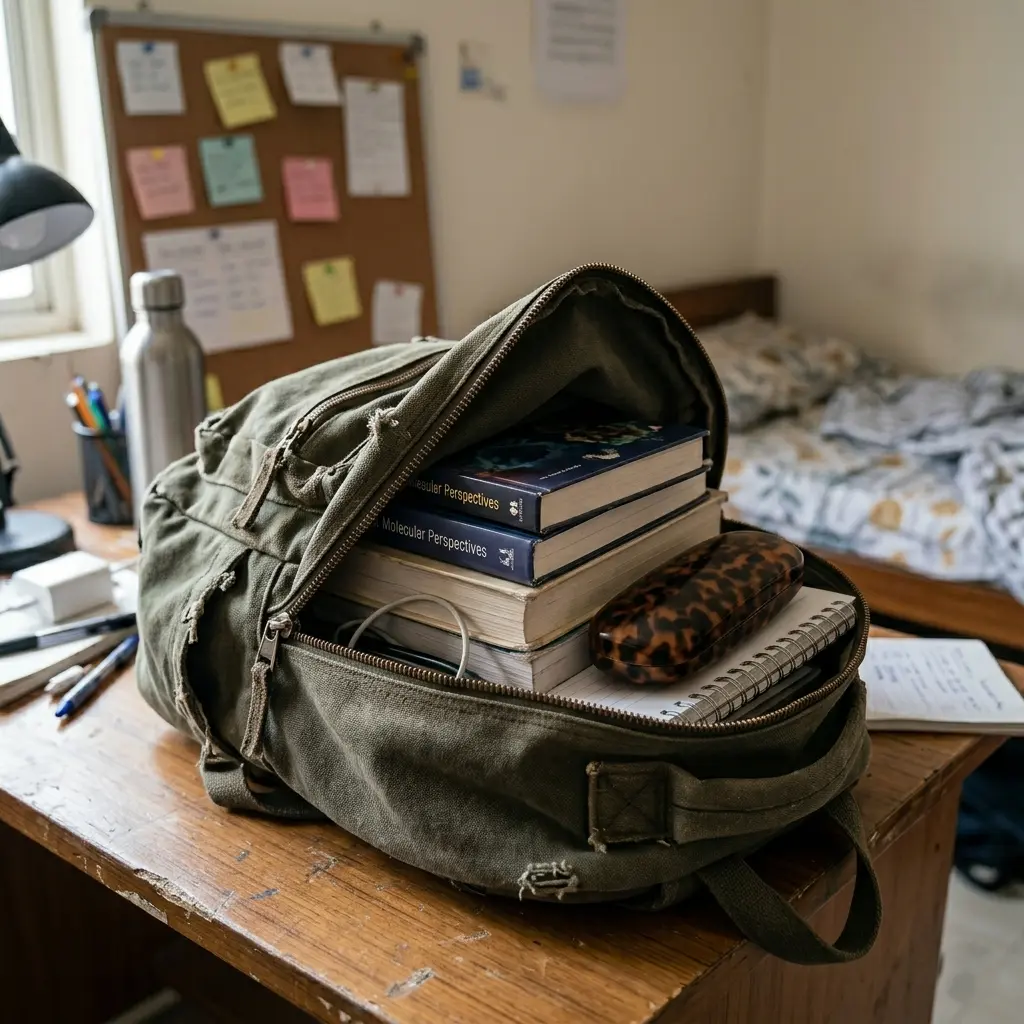
Let’s be honest. Glasses get shoved into overfull bags. They get placed face-down on desks. They get sat on. Occasionally they get knocked off a table by an enthusiastically swinging arm.
Student life is not gentle on eyewear. So durability matters.
The two things to look for here are spring hinges — the small mechanism that lets the frame arms flex outward without breaking — and scratch-resistant lens coating. Spring hinges alone extend the lifespan of a pair of glasses dramatically. And scratch-resistant coating keeps your lenses clear and functional through the entire academic year, instead of getting progressively blurrier as micro-scratches accumulate.
Fit — The Thing Most People Get Wrong When Buying Online
A perfectly specced pair of glasses on the wrong face shape is still a bad pair of glasses for you. Fit is everything — not just for comfort, but because a frame that sits wrong will affect how well the lenses actually work.

The frame width should roughly match the width of your face. The lenses should sit centered in front of your pupils. The nose pads should rest without digging in or constantly sliding down. When buying online, always check the frame measurements listed in the product details, and use virtual try-on tools if the brand offers them.
Frame Styles: What Actually Looks Good on Students in 2026

Now let’s talk aesthetics — because protecting your eyes doesn’t mean you have to look boring.
Rectangular Frames — The Classic That Always Works
Thin rectangular frames are the most consistently popular choice among Indian college students, and for good reason. They’re smart without being stiff, work on almost every face shape, and transition smoothly from a morning lecture to an evening outing without looking out of place.
Black, tortoise shell, or gunmetal — any of these colorways work with essentially every outfit. If you’re not sure what to get, a slim rectangular frame is almost never the wrong answer.
Round Frames — That Quiet Intellectual Energy
Round frames have had a massive revival among Gen Z students in India, driven equally by nostalgia and by the fact that they look genuinely great in photos and on screen. There’s a certain effortless bookish charm to round frames that fits college life perfectly.
They work best on angular or square face shapes, softening harder features. Acetate round frames in tortoise or transparent finishes are particularly popular right now — especially among arts, design, and humanities students.
Rimless and Half-Rim Frames — For the “I Don’t Want Anyone to Notice My Glasses” Crowd
Some students just want their glasses to do their job without announcing themselves. Half-rim and rimless frames are for those people. They’re the lightest option available, nearly invisible on the face, and carry a clean, no-fuss aesthetic.
Engineering and commerce students tend to gravitate toward these, especially for placement season when a more professional appearance matters. Just handle them a little more carefully — rimless frames don’t have the protection of a full frame around the lens.
Oversized Frames — Bold, Trendy, Totally 2026
Big frames are having a major moment right now across India’s college fashion scene. Oversized square and rectangular frames look confident, fashion-forward, and photograph brilliantly — which matters when half of student social life happens on Instagram.
They suit oval and heart-shaped faces best. If you’ve been looking for a reason to lean into a bolder look, this is your sign.
Buying Smart: How to Get the Best Value on a Student Budget

The best eyeglasses for students in India don’t have to cost a lot. Here’s how to shop wisely.
Put lenses first, frames second. A beautiful frame with low-quality lenses is a waste of money. Always confirm that your lenses include blue light blocking and anti-glare coating before worrying about how the frame looks. You can always find a stylish frame that has good lenses — it’s not an either/or.
Buy online — but know your measurements. India’s online eyewear market offers dramatically better pricing than physical stores for comparable quality. You can genuinely find well-built TR90 frames with blue light and anti-glare lenses in the ₹500–₹1,500 range. Premium options with better coatings and build quality sit in the ₹1,500–₹3,000 range. But to shop online confidently, know your face width and check the product’s frame dimensions.
Always get scratch-resistant coating. It’s usually a minimal additional cost and it’s completely worth it. Clear lenses stay clear all year. Uncoated lenses develop micro-scratches within months.
Buy a hard case and actually use it. The number of glasses destroyed by loose placement in a bag is genuinely saddening. A hard shell case costs almost nothing and protects your glasses from the single most common cause of damage.
Check the return policy before ordering. A brand confident in its product offers at least a 30-day return window and a minimum one-year frame warranty. If a brand doesn’t offer these, think carefully before committing.
Small Habits That Make Your Glasses Work Better
Even the best eyeglasses for students in India can only do so much if your screen habits are working against them. A few small adjustments make a big difference.
The 20-20-20 rule is the single most effective habit for reducing eye strain. Every 20 minutes of screen time, look at something at least 20 feet away for 20 seconds. This physically relaxes the muscles inside your eye that have been contracting to maintain focus. Set a phone reminder if you need to — it actually works.
Keep your screen at arm’s length — roughly 26 to 28 inches away — and position it slightly below eye level. This reduces how much of your eye is exposed and cuts down on dryness significantly.
Study in a well-lit room. Dark room plus bright screen is genuinely one of the worst combinations for your eyes. The constant adjustment between screen brightness and dark surroundings exhausts your eyes faster than you’d believe. A decent desk lamp makes a meaningful difference.
Blink intentionally. Sounds ridiculous, but we blink about 60% less when staring at screens. Dry, irritated eyes at the end of a study session are often just the result of not blinking enough. Take conscious blink breaks. Your eyes will feel noticeably better.
Frequently Asked Questions
Q: What are the best eyeglasses for students in India who spend all day on screens? Blue light blocking glasses with anti-glare coating are the most important combination for heavy screen users. Pair them with lightweight TR90 or metal frames for all-day comfort. These two lens features together — blue light filter plus anti-glare — address the two biggest sources of screen-related eye strain.
Q: Are blue light glasses actually worth buying for Indian students, or is it just marketing? They’re genuinely worth it for students with heavy screen usage. The difference in how your eyes feel after a long study session is noticeable — less burning, less fatigue, and better sleep if you wear them in the evening. They’re not a miracle, but they’re a real and affordable solution to a real problem.
Q: Which frame material is best for students in India? TR90 is the top pick for most students — it’s lightweight, tough, flexible, and affordable. Metal frames (especially titanium) are excellent for students who prefer a minimal, professional look and are willing to spend a little more. Acetate is the choice if style and color variety matter most to you.
Q: How much should a student spend on eyeglasses in India? You don’t need to spend much to get something genuinely good. Online, a solid pair with blue light blocking and anti-glare coating starts around ₹500–₹800. A better-quality pair with scratch resistance and spring hinges sits in the ₹1,000–₹2,000 range. Above ₹2,000 gets you premium build quality and better coatings that last longer.
Q: Can I wear blue light glasses all day — not just during screen time? Absolutely. Blue light blocking lenses look identical to regular clear lenses, and wearing them all day is completely safe. Many students just put them on in the morning and keep them on. There’s no reason to take them off when you step away from your screen.
Q: Online or physical store — which is better for buying student eyeglasses in India? Online wins on price and variety, hands down. Physical stores give you the advantage of trying frames before committing and getting a professional fit check. For most students on a budget who are comfortable checking frame dimensions, online is the smarter move — just make sure the brand has a clear return policy.
Final Thoughts
Here’s the honest truth: your eyes are going through a lot right now. The screen hours, the late nights, the pressure of exams — it all adds up, and your eyes feel it before the rest of you does.

Finding the best eyeglasses for students in India isn’t complicated. Blue light blocking lenses. Anti-glare coating. Lightweight frames that fit properly and won’t give up on you halfway through the semester. Get those basics right and you’ll feel the difference faster than you expect — less eye fatigue, fewer headaches, better sleep, better focus.
You invest in good headphones, a decent laptop, maybe a course or two. Your eyes work just as hard as any of those things — probably harder. They deserve the same attention.
Browse our full collection of stylish, affordable glasses and eyewear — made for students who refuse to choose between protecting their eyes and actually liking how they look.
Still unsure which frame suits your face shape or budget? Drop your question in the comments — we read every single one and we’ll help you figure it out.
Behind every great product recommendation is a well-researched content strategy. Our team is backed by expert digital marketing professionals who ensure you always get accurate, helpful buying guides — not just sales copy.